
The Bible Code in the Exodus: Mashiach Day and Night
In the following, we would like to posit another way to look at the Exodus of Israel from Egypt, specifically in reference to the guide of the people that led them to the mountain of the Lord. This episode has already been expounded by the classic commentators and by us, but there is yet more to be learned from it, as we will show below.
The Torah portion Beshalach, “When he (Pharaoh) sent” (Exodus 13:17-17:16) contains well known stories that are considered nothing short of miracles: the splitting of the Red Sea (Exodus 14-15) and the fall of manna from heaven (Exodus 16). After the ten plagues in Egypt, miracles themselves, that destroyed the economy and demography of the country, another (eleventh) plague finished the job that destroyed the military prowess of the oppressor and the death of Pharaoh, firstborn himself. When that was achieved, according to the promise to the patriarch that the nation that would oppress his descendants would be severely judged, Egypt never returned to its former glory. The children of Ya’akov-Israel were freed and soon became a nation of YHVH at Mount Sinai. But until then,
And it came to be, when Pharaoh sent the people, that Elohim did not lead them by way of the land of the Philistines, although that was nearer, for Elohim said, “Lest the people regret when they see fighting and return to Egypt”. (Exo 13:17)
Egypt was destroyed, and the fighting Elohim was concerned with was a potential war with the Philistines. One may ask: How is it that a large group of people comprising about three million and of them six hundred thousand men fit for a military service were afraid of those who would possibly fight them? Why did the Israelites not stand and fight for the land that was promised to them? The answer is: The Egyptians were masters over Israel and that generation of the Israelites who left Egypt were molded from birth to bear a slave mentality and the yoke of the Egyptians. Now however being freed from bondage they had to wage war against another enemy.
Who were the Philistines? The Philistines were close kin to the Egyptians, as Gen 10:13-14 testifies that “and Mitsrayim begat Ludim….from whom the Philistines are descended”. The Philistines being so closely related to the Egyptians (Hebrew, Mitsrayim) would stand up against the Israelites and fight them pushing them back to Egypt, where they would be enslaved again. As soon as the Philistines heard about the great miracles that plagued their relatives and that the Israelites had left Egypt, they must have recalled the promise to Avraham that the fourth generation of his descendants would return to the land of Kena’an (Gen 15:16). The Philistines remembered very well the devastating defeat they caused to the thirty thousand Ephraimites, who thirty years earlier had decided that the 400 years spoken about to Avraham ended and decided on their own to escape from Egypt. But when they entered the land of the Philistines, they were annihilated by them (see 1Ch 7:20-21). Their bones were scattered along the way in piles, as it had already been thirty years from when they departed until their brethren departed from Egypt. This tragedy was in the memory of the Israelites who now just left Egypt. This tragic moment in the history of Israel, we explained in the article “The Early Exodus of Israel from Egypt”.
Elohim did not want any re-awakening of such memories by making the people travel that route to the Land (about an eleven-day journey). He chose the longer route that would make a return to Egypt impossible until the Israelites were so far away from Egypt, that returning to Egypt would not be a feasible option. Were the Israelites to see the bones of the Ephraimites scattered on the way thirty years after, and when they had to face war against the Philistines, they would return to Egypt. And this would have been a war on two fronts, the pursuing Egyptians and the Philistines facing them. As the events turned out, however, because Elohim did not lead them into the land of Kena’an immediately via the land of the Philistines but via the long route through the wilderness, there would not have been any portion for the Reuvenites, the Gadites, and half the tribe of Manasseh on the east bank of the Jordan, which they conquered 40 years later.
So, Elohim led the people around by way of the wilderness of Yam Suph. And the children of Israel went up in marching formation with full confidence (lit. “in fives”) from the land of Egypt (see Exo 13:18).
And Mosheh took the bones of Yoseph with him, for he certainly made the children of Israel swear, saying, “Elohim shall certainly visit you, and you shall bring my bones from here with you”. And they departed from Sukkot and camped in Eitam at the edge of the wilderness. (Exo 13:19-20)
Now, while all Israel were engaged with collecting silver and gold from the Egyptians, Mosheh was engaged with Yoseph’s bones and the bones of his brothers. The bones of their fathers would travel with them in the wilderness for forty years. And on the 16th day of the month, they moved on from Sukkot and encamped at Eitam, at the edge of the desert. That was their second station in the wilderness (see also Num 33:6).
And YHVH went before them by day in a pillar of cloud to lead on the way, and by night in a pillar of fire to give them light, so that they could travel day and night. He did not remove the pillar of cloud by day and the pillar of fire by night from before the people. (Exo 13:21-22)
From these verses it becomes clear to the reader that YHVH was providing a constant protection of the people day and night by the two pillars while they were travelling. Each of these supernatural manifestations of the pillar of cloud and the pillar of fire, was unique in its function and at the same time separate from the other. The pillar of cloud was providing shade from the heat of the sun. On the other hand, the pillar of fire was providing heat and light during the cold nights in the desert. Yet, the two pillars were also united as for their origin; it was YHVH who was giving light and warmness in the nights, and it was Him who was going before Israel to give them direction in the desert, so that they could travel all day and night, until they reached the shores of Yam Suph, that is the Sea of Reeds.
Now, while it is clear who was going before the people, the following verse comes to add a new detail in the narrative that may seem to be confusing and contradicting, as we read,
And the messenger of Elohim, who went before the camp of Israel, moved and went behind them. And the pillar of cloud went from before them and stood behind them, … (Exo 14:19)
As the messenger of Elohim moved from his position when he traveled in front of the camp and went behind them, the pillar of cloud moved with him from in front of them and it stood behind them. Thus, the pillar of cloud came between Egypt and Israel. And there was the cloud and the darkness between the camps, but by night the cloud turned into a fire to give light. And the Egyptians could not come near the camp of Israel all the night because the pillar of fire was shielding the camp of Israel (Exo 14:20), nor could they see Israel because of the intense light. And once the camp of Israel was protected from the Egyptians, Mosheh stretched out his arm over the sea, and YHVH drove the sea with a strong wind all night to split the water. And in the morning when the sea was split, and the Egyptians chariots were in the midst of the sea chasing the Israelites, YHVH, we are told in verse 24, looked down onto the Egyptians through the pillar of fire and cloud and made the water closed up on the Pharaoh’s army through the arm of Mosheh.
Now, compare the three verses: “YHVH went before them” and “the Messenger of Elohim, who went before the camp of Israel”, and “YHVH looked down upon the army of Egypt through the pillar of fire and cloud” (Exo 14:24). The obvious questions present themselves:
Who was in fact guiding the people on the way; YHVH or His messenger, because they cannot be both, for it is said “His messenger”?
A similar difficulty arises with the verse Exo 13:21-22 stating that “YHVH did not remove the pillar of cloud by day and the pillar of fire by night from before the people”, but Exo 14:19 states “the pillar of cloud went from before them and stood behind them”.
And who was in the pillar of fire and cloud that was separating the Israelites from the Egyptians: the messenger of Elohim (verse 19) or Elohim Himself (verse 24)?
These verses call aloud for an explanation.
The Rabbis have discussed these questions which all should ask, and Ramban comes to explain the seeming contradiction. Rabbi Mosheh ben Nachman, also known as Ramban, was a leading Torah scholar of the Middle Ages who authored commentaries on Torah and the Talmud. In his commentary to the verse, he holds the view that it was possible that the word mal’ach (angel, but literally a messenger) is not in a construct state, i.e., “the angel of” but instead it is apposition: “Messenger the Elohim”.
Grammar insight: The term “apposition” is a grammatical relation between a word and a noun phrase that follows in an act of positioning close together or side by side, hence, Ramban’s interpretation is “Messenger the Elohim”. The term mal’ach simply means one who is sent by another to do his will. It is related to another Hebrew word, מְלָאכָה melachah, meaning work, as it appears in Gen 2:2. It comes from מַלְאָךְ mal’ach, an unused root meaning to dispatch someone. Hence mal’ach means a messenger. We now return to the text.
Thus interpreted Mal’ach ha’Elohim, “Messenger the Elohim”, could mean also “the powerful messenger” considering the definite article ha, “the” before Elohim. (In places where the term Elohim occurs with the definite article ha “the”, i.e., haElohim, it denotes a title.) Tur HaAroch, a commentary on the Torah, written by Rabbi Jacob ben Asher (c. 1269 – c. 1343), known as Ba’al haTurim, quotes Ibn Ezra (a medieval Spanish Torah commentator and grammarian) who describes the angel in question as שר הגדול, Sar HaGadol, the commander in chief of the celestial armies.
If Ramban is correct (we believe he is) that Mal’ach ha’Elohim could be interpreted as “Messenger the Elohim”, then according to the additional information we are given here in Exodus 14, “Messenger the Elohim” was “marching” in front of the Israelites day and night leading them on the way. Then, it becomes clear that it was this powerful messenger Sar HaGadol (the Great Minister) that the Torah had in mind when writing: “and YHVH went before them by day … and by night”.
And under the command of YHVH Mosheh stretched out his hand over the sea, and YHVH caused the sea to go back by a strong east wind all that night, and made the sea into dry land, and the waters were divided. And Israel went into the midst of the sea on dry ground, as the waters were like walls on their right and left. The Egyptians pursued them into the midst of the sea, and Pharaoh with them. And when the last Israelite reached the other shore, Mosheh raised his arm over the sea and towards morning of the 21st day of the first month, the month of the exodus, the waters surged back upon Pharoah’s army destroying everyone. The Creator had promised not to destroy the whole world by water but mentioned nothing about bringing it onto a single nation. He indeed punished the Egyptians by the very thing by which they had afflicted Israel throwing their boys in the Nile Now He threw the waters of Yam Suph on the Egyptians, and they drowned in the sea.
Now, the Book of Exodus is very concise as to what exactly occurred that night. Josephus in his Antiquities of the Jews 2:15:3, says that when the whole Egyptian army was within the sea, and the sea flowed to its own place, there was “a torrent raised by storms of wind”. Showers of rain also came down from the sky, and dreadful thunders and lightning, with flashes of fire. Thunderbolts also were darted upon the Egyptians. Of these storms of wind, thunder, and lightning, at the drowning of Pharaoh’s army, wanting in Exodus but existing in the psalm of David. We read,
The waters saw You, O Elohim; The waters saw You, they were afraid; The depths also trembled. The clouds poured out water. The heavens rumbled. Also, Your arrows flashed back and forth. The voice of Your thunder rolled along. Lightnings lit up the world. The earth trembled and shook. Your way was in the sea, and Your path in the great waters, and Your footsteps were not known. You did lead Your people like a flock by the hand of Mosheh and Aharon. (Psa 77:16-20)
Insight: Flavius Josephus (Yoseph ben Matityahu Ha-Kohen) was born in 37 CE and died around 100 CE. He started as a priest in the Temple and ended as a Roman citizen, surviving the destruction of the Second Temple in 70 CE. He has been recognized as a historian and as a military commander during the siege of Jerusalem by the Romans. We now return to the text.
While all these cataclysms came from the Prime Cause of all, YHVH Himself, but who was the messenger of Elohim who guided the people in their exodus. Seeing that the commentators engage in speculations, we have added our own so as to clarify what the narrative really says. We have the reason to speculate that he was the Minister of the Face, to whom we now turn,
The Bible Code
“The Bible code is the watermark of the Omniscient in His Word to assert genuineness”. Navah
The danger of a Bible code is in its misinterpretation. What is the Bible code? Simply put, the Bible code is a word or few words, embedded by the Supernal Author into the Hebrew text of the Tanak, which when read in an equidistant-letter sequence gives a hidden message. The sages consider the Bible codes the literal word of the Omniscient, because it is humanly impossible to write such a complex and intricately designed form of messaging. The odds of a certain Bible code to occur randomly in the Scripture is rather astronomical. When multiple codes overlap or appear in close vicinity and agree in the context of the plain reading of the text on the surface, it is even beyond astronomical. Therefore, the only one who can possibly write the hidden messages in the Bible codes is the Creator Himself.
What is the purpose of the Bible code? The purpose of the Bible code is to assert genuineness visible when read at certain conditions. As a genuine banknote can be recognized only by the watermark or other hidden marks indicated through a symbol, letter, or sign in it embedded by its issuer, i.e., the Central bank, and visible when the note is held up to the light, so does the Bible code serve as a “watermark” of genuineness of the Creator’s Word and as verified authenticity. A second purpose of the Bible code is to give a hidden message of wisdom and knowledge, as Psalm 119 states, “Open my eyes, that I may see the hidden things in Your Torah” (Psa 119:18). The Torah under the surface of its letters contains an abundance of such “hidden things” into which only eyes the Eternal has opened can see. Hence, the prayer of the prophet Jeremiah was answered, and he saw great and hidden things men had not known, “Call to Me, and I will answer you and will tell you great things, and hidden, which you have not known” (Jer 33:3).
What is not the purpose of the Bible Code? Bible codes cannot and should not be used to predict the future even though they may speak of the future; they are not meant for this. Rather, the Bible codes reflect the fact that there is providential evidence of future events which the Creator has engrafted into the Hebrew text. How this manifestation of His foresightful care for His Word will be interpreted and used by men is entirely adequate to the task they have been called to. With that being said, let us go deeper into our exposition.
There are hidden messages in the Bible Code in Exodus 14 and 14 that yields two amazing and overlapping codes that reads in Hebrew (the English translation is from JPS),
Note: The reader is encouraged to verify the validity of the Bible codes. The Bible codes are taken from Yacov Rambsel’s book “His Name is Jesus”, Frontier Research Publications, Inc., Toronto Ontario, unless otherwise stated, and interpreted by the present author to the best of his knowledge and understanding.
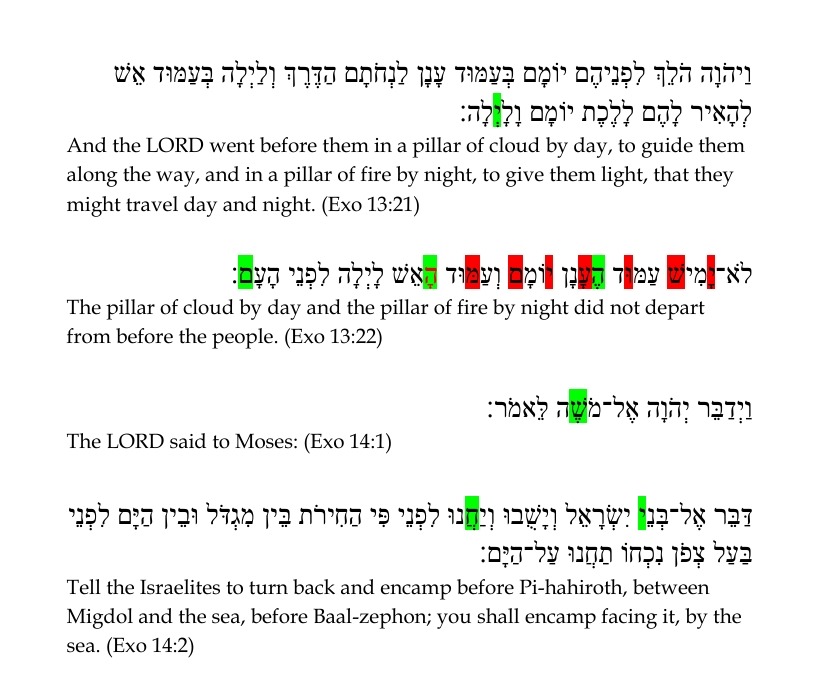
Bible Codes Exodus 13 revealing the identity of the messenger of Elohim.
Starting with letter yud in the last word of verse 21, va’lailah, “and the night” and counting every 13th letter from right to left spells out Yah HaMashiach (in green).
The second Bible code is found overlapping the first one. Starting with letter yud in the second word of verse 22, yamish, “cease”, and counting every 3rd letter from right to left ends in verse 2 of Exodus 14 to spell out Yeshua yemamah, “Yeshua day-and-night” (in red); yemamah is a term specifically denoting a full 24-hour cycle, hence, our interpretation: “day and night.
Because of the obligation that is upon us, we will interpret the Bible codes with all due seriousness and in the best way we could, and we will offer the conclusion for the reader’s consideration.
The interpretation of the Bible Codes
How do we interpret the cryptic messages encoded in the Exodus story? We are not going to pretend that we know and understand the full magnitude of the Bible codes in general and of these two in particular, but we will give our opinion for the reader’s consideration.
In rabbinic tradition, Metatron מטטרן (also Mattatron) is the unique Messenger of the Presence of the Eternal Elohim, Sar haPanim, “The Minister of the Face”, the one who bears the Tetragrammaton and he who guided Israel through the wilderness to Mount Sinai. According to the rabbinic sources (Gevurot Hashem 55:9), this Messenger of the Presence has been entrusted by the Creator to run the universe according to natural laws. In some rabbinic works, he is called also “Metatron Mashiach”, the Anointed Metatron, “the Minister of the Interior” or “The Minister of the Internal Affairs”; Metatron the angel to whom Elohim entrusted the running of His universe. As such, Metatron acts as the agent of the One Who is above him, the One who has given him this authority—the Eternal — but Metatron is not YHVH, because the prophet calls him “the Messenger of His [YHVH] Face” (Isa 63:9).
The whole subject of this celestial being may be extremely confusing for some, when we look only at what has been revealed to us in the Hebrew Scripture. In such a case, we need to resort to the writings of the Rabbis to make better sense of it. The reader’s mind will settle when he/she reads what the Rabbis say about the messenger Metatron. We read,
“Among the Sages, it is known that the name of this messenger is Metatron, which is the numerical equivalent (Ed. in Gematria) of the Omnipotent [Shaddai]. And Scripture states about him, “Behold, I will send an angel before you, etc. as My name is in him” (Exodus 23:20-21); and the sages called him the Small Omnipotent. And it is stated about him, I have been young and I have also grown old (Psalms 37:25). And all of these are found in comprehensiveness, but with [less] power”. Gevurot Hashem 55:9
Insight: Gematria is the practice of assigning numerical values to Hebrew letters. Throughout rabbinic and Jewish literature, Gematria is used as a tool for interpreting Biblical texts and deriving meaning from words and phrases. When two words or phrases have the same numerical value, it is believed that an association is thus established between them, hence, a deeper meaning can be derived from it. Gevurot Hashem makes this association between the messenger Metatron and Elohim. We now return to the text.
This Messenger of His Face is identical with the Messenger in whom the Name of the Eternal is (see Exo 23:20-21). To distinguish that heavenly being from the “angels”, YHVH calls him “My Messenger (see Exo 32:34 and Exo 33:2) and “My Face” (Exo 33:14), as someone unique and incomparably higher than the manifestation of Elohim through the mediation of “angels”. The primary texts of Kabbalah, the Zohar and Pardes Rimonim, describe Metatron as a servant of the Eternal. This unique in his service Messenger was created at the very beginning of Creation. Yochanan records in Rev 3:14 that the one he is speaking about in “the Trustworthy and True Witness, the beginning of the creation of Elohim”, is the one who became flesh. This celestial being is the true witness of the creation as he was created first at the beginning. This subject of Metatron requires a lengthy exposition, but it is all explained in our commentary in the series “The Messiah” and “The Bible Codes”, to which we would like to turn the reader’s attention.
To bring light to what we already explained, we will proceed with the interpretation of the Bible codes appearing under the surface of the Hebrew text in Exodus 13 and 14, for the Torah tries to tell us something beyond what is immediately obvious.
The two codes are “Yah HaMashiach” and “Yeshua yemamah”, “Yeshua day-and-night”. (The Hebrew name Yeshua is a short form of Yehoshua, whose meaning is “YHVH delivers”). The former identifies the one who is revealed in the latter code: Yeshua, the Messenger of Elohim, who was a full 24-hour protection of Israel in the desert, hence, “day and night. Notice how the latter code supports perfectly the Hebrew text and context.
Jewish tradition also teaches that Metatron is not a real name but a substitute for the name of מַלְאָךְ mal’ach (the messenger) spoken of in Exodus 23:20, wherein YHVH states: “My name is in him”. “Metatron” means “guide”, a unique mal’ach of the Presence, who bears the Tetragrammaton and guided Israel through the wilderness to Sinai, as it is stated in Exodus 14:19. And since the Name was in this messenger, and hence he is called, “His Face” (Isaiah 63:9), His essential nature was manifested in him, that is to say, this messenger represented YHVH in any way of power and authority, and hence Mosheh called him in Exodus 33:15, “Your Face”. But because in fact it was the Eternal who was guiding the people in the person of the messenger, He demanded unconditional obedience from the people; if they provoked Him, this messenger would not pardon their transgression as Elohim would not pardon them either, as it is said, “for he does not pardon your transgression, for My Name is in him” (Exo 23:21). Even though this celestial powerful being called Metatron bears the Name, the Rabbis stated in Babylonian Talmud, Tractate Sanhedrin 38b, that Metatron may not be worshiped.
As for the code “Yah HaMashiach”, “Yah” is a short version of the Tetragrammaton YHVH that demands the same respect and awe due to the Eternal Creator. There is no difference in their significations. How to interpret “Yah HaMashiach”, which literally reads “Yah the Anointed”, because who were higher than the Creator to anoint Him? This is difficult, because this cannot be!
A closer examination of the codes in the context of the Hebrew text on the surface shows that both cryptic messages “Yah HaMashiach” and “Yeshua yemamah” are here fitly interwoven, overlap, and even more they intersect in the Hebrew word ha’eish, “the fire”, in verse 22 of Exodus 13. We interpret this to mean that HaMashiach, “the Anointed” in “Yah HaMashiach” is none other than the one revealed in “Yeshua yemamah”, the celestial being, the anointed, that guided and protected Israel from Egypt, while the strong wind of Yah was splitting the sea.
The present author is not certain and does not claim that the conclusions drawn above are the best ones, for there are surely others to be made. Nevertheless, he believes that they follow naturally from the plain narrative inf the Hebrew text and from what is revealed to us in the Bible codes. What is certain though is that the composed above can be a ladder to help the reader ascend to the high matter of the secrets Torah keeps for those who seek understanding at a deeper level.
Knowledge known to only a few will die out. If you feel blessed by these teachings of Time of Reckoning Ministry, help spread the word!
May we merit seeing the coming of our Mashiach speedily in our days!
This page contains sacred literature and the Name of the Creator. Please, do not deface, discard, or use the Name in a casual manner.