
Trump’s “New Gaza” Plan vs. Isaiah 11. The Last War in the Middle East.
The President of the U.S. of America Donald J. Trump made his plan for peace in the Middle East known as “Trump’s Gaza Plan”. According to the “Gaza plan”, the “Palestinians” are to be relocated to other countries, after which the U.S. will take over the Gaza Strip for the purpose of rebuilding it to become what Trump called the “Riviera of the Middle East” (Riviera is the coastal area between La Spezia in Italy and Cannes in France that contains some of Europe’s most popular and expensive resorts). But when we speak today of Gaza, we should keep in mind that this is the same Gaza of the ancient Philistines which David subdued and took all their towns and made it part of the Kingdom of Israel. David also smote Mo’av (the descendants of Avraham’s nephew Lot), and its inhabitants became servants to him, thus he expanded his kingdom all the way to the River Euphrates (see 1Ch 18:1-3). Therefore, the people called today “Palestinians” are Arabs and have nothing common with the ancient Philistines whom David conquered.
Grammar insight: The Hebrew word for “Philistinian” is pelishtiy, which comes from the root verb palash, to roll (in dust). Figuratively, pelishtiy means someone who rolls from place to place, as in a similar way “a rolling stone” moves around; or the word pelishtiy means “immigrant”. The ancient Philistinians were descendants of Pathrusim, son of Mitsraim, son of Ham, son of Noach, who migrated from Caphtor (probably Crete) to the western seacoast of Kena’an, hence their name. In other words, the Philistinians are sons of Ham, while those known today as “Palestinians” are Arabs, sons of Avraham, son of Shem, son of Noach. Therefore, the Philistinians and the “Palestinians” are two different branches of the sons of Noach. We now return to the text.
This study is a further development of the article The Messianic Prophecy in Isaiah 11 and the End of Days, as the present author has added his personal understanding in order that the studious reader can obtain more knowledge of some less-obvious matters. We will explain the matter in the following vein.
President Trump’s strategy for rebuilding Gaza after the ceasefire in the war with Hamas is outlined in his “Comprehensive Plan to End the Gaza Conflict” (initially signed in late 2025). According to this plan, the U.S. administration’s vision focuses heavily on an investment-driven reconstruction model led by the private sector and political international bodies. The Comprehensive Plan to End the Gaza Conflict breaks down into specific economic, structural, and transitional governance initiatives.
What becomes transparent from the very first initiative of President Trump is his plan to bypass the standard but also bureaucratic and corrupt international channels of the United Nations. In order to accomplish this, Trump established a new international body called the “Board of Peace”, which he personally chairs to secure a full control over it. To obtain a permanent seat on this board, each participating international government must commit a minimum financial “down payment”. Countries that contribute $1 billion or more earn permanent seats in the Board of Peace. As of early 2026, several billion dollars have been pledged toward the effort.
In order to secure day-to-day public services, civil administration, etc., “on-the-ground administration” will be created: the National Committee for the Administration of Gaza (NCAG). This is a transitional body made up of 15 unelected Palestinian technocrats and international experts who report directly to the Board of Peace, i.e., to President Trump.
A key figure in creating and promoting this plan is Trump’s son-in-law Jared Kushner, who revealed the visual blueprint and map at the World Economic Forum in Davos in January 2026. The presentation outlined a heavily spatial, highly compartmentalized vision for what the U.S. administration explicitly labeled “New Gaza”.
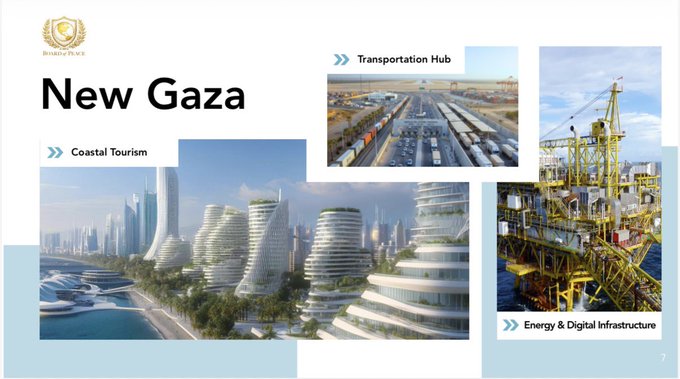
Trump’s idea of post-war Gaza at the World Economic Forum (WEF) on 22 January 2026 in Davos, Switzerland. The White House.
In this visualization of the “New Gaza”, the coastal façade looks less like a traditional Mediterranean community and more like modern Gulf metropolises. A dense beachfront corridor features up to 180 high-rise skyscrapers and mixed-use towers for tourism and luxury real estate.
Unveiled in detail by Jared Kushner at the Davos forum, the physical reconstruction of the Gaza Strip relies on free-market principles to transition Gaza away from foreign aid dependency. It is a widely known and unconfessed fact that the current foreign aid from the U.N., the European Union countries, and especially the money from countries such as Turkey and Qatar, was used to finance the building of the underground tunnels which Hamas used to penetrate into Israeli territory for terrorist activities to murder and kidnap civilians and IDF soldiers. With the free money from the international organizations and NGOs the Hamas terrorists made their rockets to shell the southern and central parts of Israel. But the goal now, according to the Comprehensive Plan to End the Gaza Conflict, is to raise Gaza’s GDP to $10 billion by 2035 through the contribution of the monies the member countries pledged. Key elements of the rebuilding of the Gaza Strip include the construction of roughly 100,000 permanent housing units, 200 schools, and 75 medical facilities in “New Gaza” and “New Rafah”, a massive “coastal tourism zone” along the Mediterranean seafront, which features concepts for up to 180 skyscrapers and high-rise mixed-use towers for businesses and tourism, massive commercial parks intended to focus on heavy data centers, digital infrastructure, and manufacturing. The plan claims that this will generate up to 500,000 jobs. For logistics and infrastructure, a new “trilateral crossing” at Rafah is planned and proposed construction of a modern commercial seaport and airport.
The U.S. Administration has repeatedly emphasized that “security comes first” in order to protect international investment of the country-members and private initiatives. For this reason, the reconstruction phase is tightly dependent on the complete demilitarization of the Gaza Strip, the complete dismantling of underground tunnel networks, and the deployment of an International Stabilization Force (ISF) to maintain order alongside a newly trained Palestinian police force. The latter raises the concerns for the security of Israel, because Turkey is the country that pushes for the deployment of such foreign troops in Gaza financed by Qatar’s money.
The Comprehensive Plan to End the Gaza Conflict has drawn starkly mixed reactions globally. Supporters view it as a pragmatic, business-minded approach capable of breaking the historical “terrorism-money- terrorism” cycle by substituting the earlier corrupt system. Critics and Hamas advocates have heavily criticized the plan as “imperialist”. They point out that it was designed without consulting the local population (understand Hamas and the Palestinian Authority).
While the Comprehensive Plan to End the Gaza Conflict presents a highly ambitious architecture, some analysts note that bridging the gap between a conceptual blueprint and the estimated $50 billion to $70 billion required for full physical layout remains a massive financial and diplomatic obstacle. As we will see below, there is another major obstacle for the implementation of Trump’s New Gaza plan. While the New Gaza in Kushner’s slideshow presents a glitzy, high-tech rendering of skyscrapers and pristine parks, the careful reader will note that there is not only a disconnect between these conceptual visuals and the reality on the ground but also a massive disconnect from the biblical prophecy.
A question arises itself: What does the Messianic prophecy in Isaiah 11 say concerning Gaza? The answer is found in the verses below directed at the nation of Israel and the Philistines.
Since the spilt of the Kingdom of Israel after Solomon, the jealousy and hatred existed between the Northern Kingdom of Israel and the Southern Kingdom of Judah. But after the Mighty Guardian of Israel will raise a banner for the nations and gather the exile of Israel, He will assemble the nation from the four corners of the earth, and the internal conflict in the State of Israel will turn aside, and its enemies be cut off (see Isaiah 11:12-13) with the coming of His anointed, the Messiah. When this becomes fulfilled, the jealousy of the nations who have fought against Israel, and its enemies from within and without, will cease. The discord and division in the Israeli society will be taken out by the Messiah, and Israel will reunite to fight the enemies, as it was in the days of King David.
As we ask in the preceding article, if the nations of the world will come to the realization that they have sinned before the Lord by oppressing His people, and no nation will lift up again sword against nation (see Isaiah 2:4), neither will they learn how to wage war any longer, against whom will Israel fight? The Messianic prophecy in Isaiah 11 indicates that there is one more battle that must take place before world peace is indeed established. We read concerning this final battle in the following verses,
But they [Ephrayim and Yehudah] shall fly down upon the shoulder of the Philistines toward the west. Together they shall spoil the people of the east, their hand stretching forth on Edom and Mo’av, and the children of Ammon shall be subject to them. And the Eternal One shall put under the ban the tongue of the Sea of Egypt, and He shall shake His hand over the River and smite it with the might of His Wind into seven streams and shall cause men to march it in sandals. (Isa 11:14-15)
Who are the people that live today in the land on both sides of the Jordan? And where are today the Edomites who lived there before them? If these are two separate peoples, where did the Edomites go and where did “the Palestinians” come from?
There is no indication in the Scripture that the Edomites, the Ammonites, and the Moabites featured in the prophecy were destroyed completely in such a way that no trace of them can be found in the annals. And if we can find them in the end-time prophecy in Isaiah 11, then they must still exist exactly where the prophecy finds them—in the land of their ancestors—the Ammonites in what is now the Northern Jordan, the Moabites in the Middle Jordan, and the Edomites in the Southern Jordan. But if they still live in the land east of the Jordan River, then we must acknowledge that the Edomites, the Ammonites, and the Moabites, and the people that comprise about 90 percent of the population of the Hashemite Kingdom of Jordan are the same people, but under different names.
So, who were the people, who live in the land on both sides of the Jordan River, and where did they come from? And where did the Edomites (the brothers of the Israelites, who lived on the eastern side of the Jordan before them) go? Hence, the question that is almost forced upon us is: Who are the people today, who call themselves “Palestinians”, and where did they come from, for we find no such ancient people in the annals? How did the tiny sliver of land the Eternal gave to His people become “Palestina” and then “Palestine”, and who are the people called today “Palestinians”? For further knowledge of the matter, the reader will do well to read what we have written in our commentary in The Palestinians—the Indigenous People in the Hashemite Kingdom of Jordan.
Returning to our verses, it seems incomprehensible that there will be room for another war after the war of Gog of Magog and the Messiah’s arrival. Yet, it is written that Ephraim and Yehudah will unite to defeat their common enemies. Then, Israel will run quickly (literally, “fly down”) in one accord [one shoulder, or shoulder to shoulder] over “Palestine”. This description looks like a war after the coming of the Messiah and the establishment of world peace. Does it not? How do we understand it? We will now remove all the difficulties.
The ancient Philistines once occupied that land which is known today as Gaza. The Philistines ceased to exist when King David conquered their land and appropriated it in his kingdom. That land is located west of Israel, as it is said, “But they shall fly down upon the shoulder of the Philistines toward the west”.
The people who occupy Gaza today are Arabs and have nothing to do with the Philistines. They came in the region with the Arab conquest. Once Israel was in control of Gaza until it was forced to leave it under the foreign pressure. Bear in mind that Israel took back Gaza as booty of war, as a result of the defensive wars against the surrounding Arab nations in the 60’ and 70’. But now it is prophesized that Israel will reconquer Gaza and will run quickly as if they were flying with wings to do the same to the east, that is, the Syrians, Edom, and Moav and Ammon. And these peoples will be subject to Israel, as it is said, “Together they shall spoil the people of the east, their hand stretching forth on Edom and Mo’av, and the children of Ammon shall be subject to them”.
And the waters of the Egyptian sea and the Euphrates River will be cut off to dry it, so that the exiles of Israel will pass through on dry land from Egypt and from Assyria. And into seven streams, that is, into seven segments the exile from Egypt and Assyria will be divided, so that Israel will easily come into the Land, just as they came out of Egypt under Mosheh, as it is said, “And the Eternal One shall put under the ban the tongue of the Sea of Egypt, and He shall shake His hand over the River and smite it with the might of His Wind into seven streams and shall cause men to march it in sandals”.
And there shall be a highway for the remnant of His people, those left from Assyria, as it was for Israel in the day when he came up from the land of Egypt. (Isa 11:16)
And there shall be a highway in the midst of the water for the remnant of His people. There will be a road on which they will go through the great rivers, just like when Israel went out of Egypt on dry land. Alternatively, this verse describes the utter [not necessarily physical] destruction of all lands to which Israel had been exiled (see verse 15). What has been described here in verse 15 and 16 is a metaphorical description of the grand return of Israel. In other words, just as Israel’s exodus out of Egypt was, so like walking on a highway will be the second exodus, when all Israel will return. That this battle will be the final one is expressed in the verse, “And in that day there shall be a Root of Yishai, standing as a banner to the people” (Isa 11:10). And in the next verse, it is also said, “And it shall be in that day that YHVH sets His hand again a second time to recover the remnant of His people, etc.” (Isa 11:11). We do not know which verses can be more explicit than these in Isaiah 11 because it reads clearly that the next Gaza war will be the final one.
It is evident why a broad consensus has developed among all commentators that this interpretation applies Chapter 11 of Isaiah to the King Messiah, a shoot of Yishai (symbolic of the royal scepter), who shall come and redeem Israel. Thus, this description relates to the last days of this world and therefore renders the whole chapter as Messianic.
What is the relevance of this here? And what does Isaiah 11 teach?
There is an ongoing war of the U.S. and Israel against the Islamic Republic of Iran and its proxies, which is interrupted and resumed on several occasions because President Trump wants to negotiate with people who do not want to negotiate. We have the strong reason to believe that this unconventional war may be a part of the final war prophesied in the books of Ezekiel, Zechariah, and Isaiah.
The most contested real estate in the world was bought with money, as we read,
And he [Ya’akov] bought the portion of the field where he had pitched his tent, from the children of Hamor, Shechem’s father, for one hundred kesitah. And he erected an altar there and called it El-elohe-Israel. (Gen 33:19-20).
The city of Shechem is mentioned several times in the Torah in reference to the patriarchs. It was the first place in the land of Israel that Avraham entered and where YHVH appeared to him, and the site of the first altar to YHVH. Two generations later, it was the place Ya’akov first settled in after his return from Mesopotamia, and the place where he bought the field to live on. Shechem was the place where Yoseph met his brothers and where they sold him into slavery. Shechem is the place, where Ya’akov’s great-grandson Yehoshua buried the bones of Yoseph, when Israel entered the Land; on the same field that Ya’akov bought from the sons of Hamor. This purchase of the field in Shechem showed that Ya’akov relying upon the promise of YHVH, regarded the land of Kena’an as his own home and the home of his children.
Yet, despite Trump’s “New Gaza” plan, the reality on the ground is quite different. If the Arabs accept under the pressure of the United States Israel’s existence as axiomatic and are forced to join the Abrahamic Accords, as President Trump demands, then the Israeli-Palestinian conflict could move into a new phase in which the problem is no longer whether Israel should exist or not, for that would be accepted, but about its borders. It seems that all diplomatic efforts of the U.S. administrations so far have been going in that direction, namely, to bring “the Palestinians” and Israelis around the negotiation table to make the compromise to accept each other and negotiate only the borders of the two states. Several Arab states like Saudi Arabia, the Gulf Arab states, and Egypt, have already indicated their readiness to accept the Trump administration’s diplomacy towards Israel’s existence as a Jewish state under certain conditions, and make the whole conflict a mere political dispute between Arabs and Israelis about pre-1967 Israel’s borders. If this is what will transpire in Trump’s plan and if this diplomacy succeeds in some form or the other, this may open wide doors for the end-time events, when the wrath of Mighty One of Israel will be poured out on the Earth, as He certainly will not accept the borders of the Land He gave to the children of Israel (Gaza included) to be a subject of negotiation and trade. The “New Gaza” plan will never succeed. The prophet wants us to know this.
The subject of the final war is far from being exhausted with this teaching, and we do not pretend that we possess the ultimate knowledge of the events described in Isaiah 11, and the reader should not expect us to write everything about it. But we hope that we have provided a new understanding and answers to the questions a studious reader may have had regarding it.
Suggested reading:
Trump’s Gaza Plan and the Lesson Learned by the Maccabees
Knowledge known to only a few will die out. If you feel blessed by these teachings of Time of Reckoning Ministry, help spread the word!
May we merit seeing the coming of our Mashiach speedily in our days!
This page contains sacred literature and the Name of the Creator. Please, do not deface, discard, or use the Name in a casual manner.