
The Land of Israel as the “Navel of the Earth”
Israel is the land of natural marvels unique only to her, like the saltiest sea, which is also the lowest point on the earth, that is the Dead Sea, Grand Canyon that resembles the Grand Canyon in the U.S., six distinctive climate zones, and two deserts (the Judean Desert and the Negev Desert). Israel is widely referred to as the “Start-Up Nation”, because it produces more start-ups and attracts more venture capital per capita than almost any other country. With scarce natural resources like water, limited land mass, and geopolitical isolation from Arab neighbors and constant wars, Israel relies on highly educated and experienced human capital, advanced technology, and AI. Israel’s water recycling and desalination systems are well known worldwide. Despite the scarce natural resources and limited land mass, Israel is able not only to satisfy the domestic market but also to export agricultural products abroad thanks to being a pioneer in agricultural technology, turning arid desert conditions into highly productive farmland through extreme water efficiency, micro-climate management, and automated monitoring systems. And all of this in a country that is so small that its name does not even fit into its territory on the map.
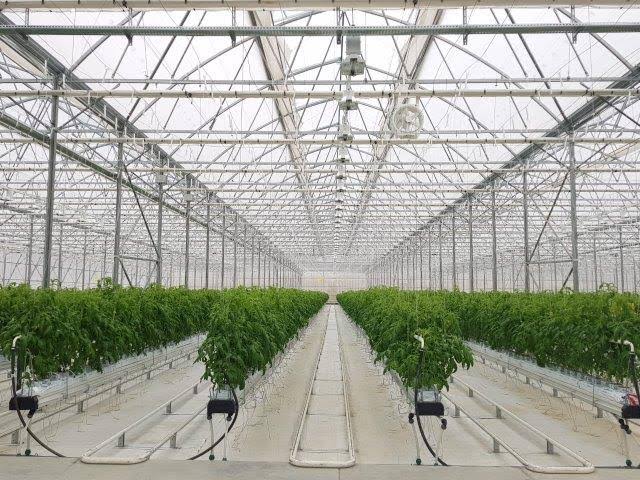
Fully controlled climate-tech glasshouse facility with precision drip irrigation, hydroponics & soilless cultivation. Source: Israel Agricultural Technology & Innovations Hub
How has such a small country of ~10.25 million residents managed to achieve and sustain all of this? Because the Israeli culture embraces chutzpah—boldness and a willingness to challenge authority and conventional wisdom. YHVH Himself called the children of Israel “a stiff-necked people”, which if we think about it is not necessarily a bad thing. It conveys a refusal to bow head, bend, or submit; all depends on the historical context before whom Israel refused to bow head and submit. “Stiff-neckedness” became the key to Jewish survival throughout centuries of exile, persecution, and pressure to assimilate. The same national and cultural trait that made the ancient Israelites difficult to submit before the Most High also made them fiercely resilient and uncompromising in preserving faith, identity, and values against all odds. Yet, in the following, we will posit another way to look at the Land of Israel with its unique features.
The Navel of the Earth
Thus said the Master YHVH,
This is Yerushalayim which I have set in the midst of the nations, with the other lands all around her. (Eze 5:5)
The Eternal told the prophet that He had set Yerushalayim (Jerusalem) in the midst of [all] nations, that is, at the center of the world, with all the countries around it, as the city is indeed seen as the moral center of the world, as it says in Isaiah 2:3 “For Torah shall come forth from Tzion, the word of the Eternal from Yerushalayim”. And if we zoom in close enough and enter the Temple, it should not come as a surprise that the Ark of the Witness behind the dividing curtain in the Temple in the Most Set-apart Place of the earth covers “the navel of the earth”: the center of the world. This is the place on the earth the eyes of the Eternal, the Elohim of Israel, are always on it.
The Word of the Servant
While Genesis is a narration by the Messenger of YHVH to Mosheh, for he could not have possibly known how the world had been created, and Exodus, Leviticus, and Numbers are the personal and direct revelation of the Most High through His servant, who put them in writing, Deuteronomy (Devarim), however, is Mosheh’s work, his book. Deuteronomy is not a mere conclusion of Torah, nor its repetition, but the final stroke of revelation of the Eternal through the words (Devarim) of Mosheh.
Mosheh rebuked the people every time they sinned, but he also prayed to defend them before the Eternal. In the last days of his life, he recalled to them all the sins they had committed in the past 40 years.
The Torah portion Eikev, “Because” (Deu 7:12-11:25), begins with Mosheh’s words,
And it will be, because you will heed these ordinances and keep them and perform, that the Eternal, your Elohim, will keep for you the Covenant and the kindness that He swore to your forefathers. (Deu 7:12)
It is a strange way for Mosheh to employ the Hebrew word עֵקֶב eikev which literally means “heel” instead of the simple כִּי kiy, “because”, which seems to be more appropriate here. In Biblical Hebrew, the beginning of something is referred to as rosh “head”, as in Genesis 1:1, wherein the beginning of the world is described. But the Torah also employes eikev “heel” to illustrate the end of something. So, why did Mosheh use eikev, and not kiy, which word indicates causal relations, or even im, “if”, which is a conditional clause. The Torah commentators see a connection between עֵקֶב eikev and the word עָקֵב akeiv, “heel”, which has the same spelling but different vowels (see Gen 3:15 and Gen 25:26), or figuratively, “steps” (Psa 56:6). Both עֵקֶב eikev and עָקֵב akeiv, “heel”, come from the primitive verb עָקַב akav which literally means to restrain, to hold back, as seen in Job 37:3-4. So, what is the connection between them?
Ramban while agreeing with the other Torah commentators adds a new interpretation, which seems to be the correct one. He says that as the meaning of the word eikev is “heel”, i.e. the end [of the body], the verse can be interpreted to mean: “and it will the end”. The verse here is thus stating: “and the end [the ultimate consequence] of your hearkening to the ordinances and your observing them is that the Eternal will keep the Covenant and the kindness, … and He will love you (verse 13)”. Alternatively, just as the heel is the end of the body, eikev in this context implies the end of time, “in the end” there will be reward.
Furthermore, Mosheh said about the land the Eternal had sworn to the forefathers to give,
You shall guard the commands of the Eternal your Elohim to walk in His ways and to fear Him. For the Eternal your Elohim is bringing you into a good land, a land of streams of water, of fountains and springs, which flow out of valleys and hills, … (Deu 8:6-7)
Mosheh contrasted the land of Israel with the desert the people lived in the past 40 years emphasizing its uniqueness. And indeed, we find six climate zones in the Land of Israel. In classical Rabbinic literature, the Sages divide the Land of Israel into six distinct geographic and climatic regions for legal, agricultural, and geographic purposes. This division is most famously detailed in the Mishnah (e.g., Shevi’it 9:2 and Pesachim 4:8) and expanded upon in the Talmud. Because the Land of Israel has varied topography—ranging from sea level to high mountain (Hermon)and deep depression (the Dead Sea region)—the Sages categorized six regions.
The Six Regions in the Land
The Sages divide the Land into three primary territories—Judea, Galilee, and Transjordan—and subdivide each into Upper and Lower regions based on elevation, climate, and vegetation patterns. They are as follows:
- Upper Galilee (Galil Elyon)
Geography & Climate: This is the mountainous, high-elevation northern region of Mount Hermon. This region is categorized as having cold winters with snow, cool summers, and high annual rainfall.
- Lower Galilee (Galil Tachton)
Geography & Climate: This is the region of lower hills and valleys south of Upper Galilee, featuring a milder Mediterranean climate with fertile valleys.
- Upper Judea / Judean Mountains (Har Yehudah)
Geography & Climate: This is the central elevated spine including Jerusalem, Hevron, and Bethel, characterized by crisp, cool mountain air, dry summers, and cold, wet winters. The Upper Judea is famous for terraced farming, olive groves, and vineyards.
- Lower Judea / The Lowlands (Shephelah)
Geography & Climate: The rolling foothills transitioning between the Judean Mountains and the coastal plain. The Lower Judea has warm, Mediterranean climate with moderate humidity and fertile soil. This is the prime area for field crops and sycamore forests.
- The Judean Wilderness & Valley (Midbar & Emek)
Geography & Climate: This is the eastern rain-shadow slope dropping down to the Jordan Rift Valley and Dead Sea. It is extremely hot, arid desert climate with very low rainfall. Date palms and oases (e.g., Jericho) are watered by springs rather than direct rainfall.
- Transjordan (Ever HaYarden)
Geography & Climate: The Transjordan plateau regions are located east of the Jordan River (historically allotted to the tribes of Reuben, Gad, and half of Manasseh). Climatically they are divided into high, cooler tablelands and deep, arid river valleys.
Why have the Sages categorized these 6 regions? For governing the Sabbatical and First fruits laws. Because crops ripen and die off at different times in cold mountains versus hot valleys, the Sages instituted that each of these six regions operates on its own timeline. The earliest-ripening crops were brought to the Temple in Jerusalem. Differences in climate meant, for example, that Lower Galilee would produce ripe figs and grapes weeks before the high mountains of Judea.
The Land of the Seven Species
… a land of (1) wheat and (2) barley, of (3) vines and (4) fig trees and (5) pomegranates, a land of (6) olive oil and (7) honey, … (Deu 8:8)
Mosheh here emphasized what was growing in the land of Kena’an. The products mentioned include the honey from dates and pomegranates. The Seven Species (Shiv’at HaMinim) span across Israel’s diverse microclimates and agricultural zones, each species thriving in specific regions best suited to its elevation, soil, and climate needs. And this is the regional distribution of the Seven Species:
- Wheat (Chitah)
Primary Regions: Jezreel Valley, Northern Negev, Coastal Plains.
Microclimate & Agricultural Conditions: Thrives in wide, flat valleys and open fields with moderate seasonal rainfall. Modern irrigation has expanded wheat farming deep into the arid northern Negev.
- Barley (Se’orah)
Primary Regions: Negev Desert, Judean Foothills.
Microclimate & Agricultural Conditions: Highly drought-tolerant. Historically and modernly grows along desert fringes and drier regions where wheat struggles.
- Grapes (Gefen)
Primary Regions: Golan Heights, Upper Galilee, Judean Hills, Samaria.
Microclimate & Agricultural Conditions: Prefers cooler, high-altitude mountain regions with rocky, well-draining soil and large temperature drops between day and night.
- Figs (Te’enah)
Primary Regions: Galilee, Judean Hills, Coastal Plains (Sharon Plain).
Microclimate & Agricultural Conditions: Grows across lowlands, coastal areas, and mountain slopes. Requires long, warm summers and moderate moisture.
- Pomegranates (Rimon)
Primary Regions: Galilee, Sharon Plain, Jordan Valley.
Microclimate & Agricultural Conditions: Flourishes in areas with mild winters and dry, hot summers. Israel’s river valleys and northern plains produce high-yield pomegranate orchards.
- Olives (Zayit)
Primary Regions: Galilee, Samarian Hills, Judean Hills, Golan Heights.
Microclimate & Agricultural Conditions: Highly resilient and long-lived; grows extensively throughout the rocky, terraced hillsides of northern and central Israel, as well as parts of the Negev.
- Honey (Devash)
Primary Regions: Jordan Valley, Dead Sea Basin, Arava Valley.
Microclimate & Agricultural Conditions: Requires extreme desert heat and abundant groundwater. Date palm groves stretch almost exclusively along the Syrian-African Rift Valley from the Sea of Galilee down to Eilat.
Good Land, Protected Land
… a land in which you eat bread without scarcity, in which you do not lack at all, a land whose stones are iron and out of whose hills you dig copper. (Deu 8:9)
The above said agricultural products that are grown successfully in the Land of Israel are abundant in it. This is the meaning of the word, “without scarcity and nothing is lacking at all”. The phrase teaches that the Land will provide its inhabitants with the means to acquire anything needed for a thriving economy and agriculture. And indeed it is so. Irael today is the leading start-up country in the world.
Nachmanides (Ramban) interprets the phrase “whose stones are iron and out of whose hills you dig copper” in the verse to mean, “in the place where you expect to find stones, you will find iron, and out of whose mountains you will hew copper” (See also Job 28:2). “But the absence of a source of silver and gold”, continues Ramban, “is no deficiency in a land”. But how about the deficiency of oil and natural gas in the Land of Israel?
… And you shall eat and be satisfied, and shall bless the Eternal your Elohim for the good land which He has given you. (Deu 8:10)
We do not find any other place in the entire Torah except here where the Lord commands His people to bless His Name (The Tetragrammaton). This is also the commandment to bless the Cause of all blessings after meal. Job 35:7 makes this point when he says: “if you are righteous what do you give Him? What does He receive from your hand?”
What the Eternal does every day
For the land which you are going in to possess is not like the land of Egypt from which you have come, where you sowed your seed and watered it by foot, as a vegetable garden, but the land which you are passing over to possess is a land of hills and valleys, which drinks water from the rain of the heavens, a land which the Eternal your Elohim looks after. The eyes of the Eternal your Elohim are always on it, from the beginning of the year to the latter end of the year. (Deu 11:10-12)
The Rabbis in Sifrei 11:11 state that the mountain land [of the Promised Land] is superior to the land of the plain [of Egypt]. They make the point that the plain, that is a flat land, in an area of land can produce a measure of grain, while the mountain land can produce five measures: four from its four slopes and one on its summit. Makes a lot of sense, does it not? Mosheh goes on to say that while the land of Egypt is irrigated by the Nile, and the Egyptians do not have to do much but to dig canals, the children of Israel have to rely on rain and be totally dependent upon the Eternal, their Elohim. The passage concludes that “the eyes of the Eternal your Elohim are always on it [the land]”. This verse is the only time the Bible tells us what the Creator does each day all year around: He focuses His eyes on the Land of Israel–to protect, to provide its lawful inhabitants.
But this does not come unconditionally,
And it shall be that if you diligently obey My commands which I command you today, to love the Eternal your Elohim and to serve Him with all your heart and with all your soul, then I shall give you the rain for your land in its season, the early rain and the latter rain, and you shall gather in your grain, and your new wine, and your oil. (Deu 11:13-14)
Both types of rain, Mosheh used, the early rain and the latter rain are necessary for an optimal yield: the early rain, which thoroughly sates the soil and the seeds, falls after sowing-time, enabling the sown seed to germinate and grow, and the latter rain, which falls just before harvest-time (Pesach-time) to fill the grain on its stalks, thus bringing it to full ripeness. The different words for rain are not simply a product of the agricultural importance of rain; they refer to different ways in which the Creator provides, offering exactly what the land needs and when it needs it. Mosheh thus assured the people that they rather than their enemies would gather in the fruits of the land.
Natural Marvels of Israel
- Makhtesh Ramon (Ramon Crater)
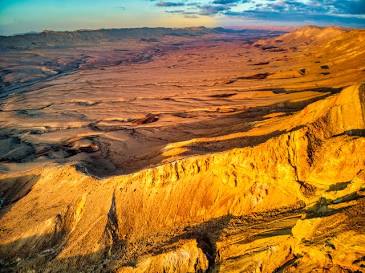
Makhtesh Ramon (Ramon Crater)
Often referred to as “Israel’s Grand Canyon,” Makhtesh Ramon is the largest erosion crater (makhtesh) in the world, stretching roughly 40 km (25 miles) long, 2 to 10 km wide, and over 500 meters deep. Unlike impact craters, it is believed to have been formed by underground water erosion that hollowed out softer rock beneath a hard limestone surface crust. Or, perhaps it was formed somehow during Noach’s Flood.
Makhtesh Ramon (Ramon Crater) is located in southern Israel, situated in the heart of the Negev Desert approximately 85 kilometers (53 miles) south of the city of Be’er Sheva and about 150 kilometers (93 miles) north of the Gulf of Eilat.
- Ein Avdat & Nahal Zin Canyon
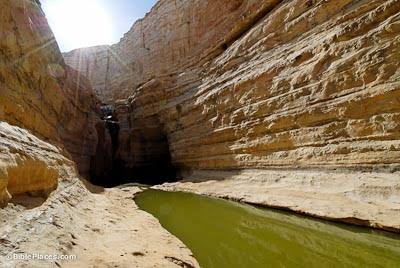
Ein Avdat & Nahal Zin Canyon
Located in the central Negev, Nahal Zin is a deep dry riverbed lined with sheer white limestone cliffs. Within it lies Ein Avdat, a narrow canyon with natural springs, pools, and high vertical walls that closely resemble the side canyons and plateaus surrounding the Colorado River in the U.S.
A Nation in a constant war to survive. The Sevent-front War.
Israel is the only country in the world that is able to fight against multiple enemies on 7 fronts, not to mention to the simultaneous wars the country was forced to wage against the surrounding Arab countries that started in 1948 and continues until now. The term “seven-front war” refers to a statement made by Israeli leadership (notably Prime Minister Benjamin Netanyahu and Defense Minister Yoav Gallant) describing the multi-arena conflict Israel has faced. The seven primary fronts defined by Israeli defense officials are:
- Gaza – The war against the Iranian proxies Hamas, Palestinian Islamic Jihad, and other small terrorist groups in the strip.
- Lebanon – The war along the northern border with Hezbollah, the Iranian-backed proxy.
- Judea and Samaria (the so-called “The West Bank”) – Counterterrorism operations of Israeli security forces against various militant cells and Palestinian factions.
- Syria – Strikes targeting Iranian-backed militias, arms transfers, and proxy infrastructure.
- Iraq – Directing counteractions and defense against long-range drone and missile attacks launched by Iranian-aligned militias (e.g., the Islamic Resistance in Iraq).
- Yemen – Air strikes against and responding to long-range drone and ballistic missile launch from the territory of Yemen held by the Houthis (another Iranian proxy).
- Iran – Direct engagements in air strikes, missile exchanges, and intelligence operations that started in 2025 (the 12-day war) and in 2026 against the central backer of all regional proxy network of the above-mentioned terrorist groups.
Together, these seven fronts represent the seven key geographic regions and militant networks that make up what Iran has created and refers to as the so-called “Axis of Resistance” against the Jewish state.
Israel: From a dependent to the natural gas exporter
This is the blessing in Deuteronomy 33 (penned by Yehoshua) with which Mosheh the man of Elohim blessed the children of Israel before his death. And of Asher, the second son of Zilpah, the servant of Leah, Mosheh said,
Asher is most blessed of sons. Let him be accepted by his brothers and dip his foot in oil. (Deu 33:24)
The verse indicates a very fruitful soil, which Asher received as his inheritance of the lowlands of Carmel on the Mediterranean coast as far as the territory of Tyre. This was one of the most fertile parts of the land of Kena’an abounding in wheat and oil. “Dipping the foot in oil”, like in a spring with oil, points to a land flowing with the fat of a fertile land, which Ya’akov had already promised to Asher (see Gen 49:20). The patriarch prophesied that from the territory of the tribe of Asher would come forth the richest foods of the land, because his land was blessed with many olive trees whose fruits would be the king’s delicacies. But such a blessing of living in fertile land rich of oil requires security for the enjoyment of this blessing. To complete the blessing Mosheh promised in the next verse,
Your locks are iron and copper, and the days of your old age will be like the days of your youth. (Deu 33:25)
Now, Mosheh addresses either Asher or all Israel, who will dwell in border cities that will “lock up” the Land with locks and bars made of iron and copper as in protection, so that no enemies will be able to enter the Land. This seems to be a poetical expression for a strong and impregnable [air] defense system, which Israel now indeed possesses, a protection as if built of iron and brass. Mining is perhaps referred to here, as the territory of Asher, which reached to Lebanon, may have contained brass and iron (see Deu 8:9). And indeed, the prediction made by Mosheh here came to its fulfillment when the children of Israel returned to the Land and established the Third Commonwealth in 1948.
Once the former Israeli Prime Minister Golda Meir wittily joked that after being in the desert (the Arabian Peninsula known today with its strategically important resources of oil) for 40 years, Mosheh brought the children of Israel to a tiny sliver of land that has no oil or gas. This was true until the recent discovery of two massive deep-water gas fields off the coast of Haifa that have seemingly prophetic names: Leviathan (see Psa 104:26-27) and Tamar (Yehudah’s wife). Most Hebrew grammarians agree that “honey” (devash) in Hebrew usually refers to the syrup extracted from dates, not necessary only to the bees’ honey. The Hebrew word for “date” is Tamar!
So, the Tamar and Leviathan gas fields shifted Israel from a net energy importer to a regional natural gas exporter to Egypt, Jordan, Cyprus, and Greece. Below is the breakdown of who discovered them, when, their volume and quality, and operational dates.
- The Tamar Field
The Tamar gas field is located ~90 km west of Haifa in the Levantine Basin (water depth ~1,700 meters) and was discovered in January 2009 by an exploration consortium led by US-based Noble Energy (acquired by Chevron in 2020) alongside Israeli partners including Isramco, Delek Drilling (now NewMed Energy), and Ratio. Chevron remains the primary operator of the gas field. Its reserve is estimated to be roughly 10 to 13.7 trillion cubic feet of natural gas (approx. 300–389 billion cubic meters). The natural gas is of excellent quality — characterized as “dry and sweet” gas (composed predominantly of pure methane with low impurities like sulfur or heavier hydrocarbons) requiring minimal onshore/offshore processing before use. The Tamar gas field became operational on 31 March 2013. Fast-tracked to supply local electricity plants after gas supply from Egypt was disrupted in 2011–2012.
- The Leviathan Field
The Levithan gas field is located ~130 km west of Haifa (water depth ~1,600–1,700 meters) and was discovered in December 2010 by the same core consortium led by Noble Energy (now Chevron Mediterranean Limited), together with Delek Drilling (NewMed Energy) and Ratio Energies. As it is with the Tamar gas field, the Levithan field is operated by Chevron. This is Israel’s largest natural gas reservoir. Its reserve is estimated to be roughly 22 to 22.9 trillion cubic feet of recoverable natural gas (~605–650 billion cubic meters), plus tens of millions of barrels of associated condensate. The quality of the natural gas is of high-grade, predominantly methane natural gas. Liquids (condensate) are separated during production on a massive offshore platform 10 km off the coast of northern Israel before dry gas is fed into the national transmission grid. The Levithan gas field became operational on 31 December 2019.
This is the Land of Israel! In addition to all said above, Israel not only has the military prowess to wage war on seven fronts, but it has more military power that Great Britain and France (nuclear powers), and Germany combined. Israel is a country from which the NATO countries buy weapons and receive intelligence. And all of this comes from a country smaller than the State of New Jersey. The merit Israel accumulates by such an act of blessings by the Creator ensures that He will continue to favor His people with His benevolent magnanimity. This places Israel in the “navel” of the earth, where the umbilical cord from heaven was attached, the ladder the patriarch Ya’akov saw in heaven.
Knowledge known to only a few will die out. If you feel blessed by these teachings of Time of Reckoning Ministry, help spread the word!
May we merit seeing the coming of our Mashiach speedily in our days!
This page contains sacred literature and the Name of the Creator. Please, do not deface, discard, or use the Name in a casual manner.